

Courageously Clapping Back Against Colorism and a NEW BOOK with Solutions

Fam,
If we needed a reminder that colorism is a worldwide cancer that never goes into remission, check out how popular Kenyan music icon Nyota Ndogo pushed back against vile colorist attacks when announcing her July 10, 2026, concert in Dar es Salaam, Tanzania.
While on the surface the idea of colorist wars in beautifully melanated African nations seems a bit mind-boggling, let us not forget how powerfully the vestiges of colonialism linger and fester in the motherland and beyond.
I’m sharing the article below to remind us that the colorist caste system spans the globe while keeping most if not all of humanity in a chokehold, and because this article drops serious wisdom about colorism and its spawn, the multi-billion-dollar global skin bleaching industry.
Fortunately, renowned colorism expert Dr. Sarah L. Webb has a new book out on the topic to help us fight this madness. But first, check out this article from what I believe is a Kenyan news platform:

NOTE: Bongo Flava is described on Wikipedia as, “a nickname for Tanzanian music.[1] The genre was developed in the 1990s, mainly as a derivative of American hip hop and traditional Tanzanian styles such as taarab and dansi.[2] Lyrics are usually in Swahili or English.[3][4]”
“Kenyan music icon Nyota Ndogo has ignited a fierce cross-border debate on systemic colorism after revealing the intense discrimination she faced regarding her dark skin complexion during a high-profile visit to Tanzania.
“The veteran vocalist, who traveled to Dar es Salaam to participate in celebrations marking a decade of a major Bongo Flava milestone scheduled for July 10, 2026, utilized her expansive digital platform to confront the deeply entrenched beauty standards plaguing the East African entertainment industry. Nyota Ndogo disclosed that upon her arrival, she was subjected to relentless, unsolicited commentary about her melanin-rich skin, with detractors explicitly describing her as “dark as charcoal.” Her public condemnation exposes the dangerous psychological and economic forces driving the multi-billion-dollar skin bleaching industry, laying bare a crisis that continues to marginalize dark-skinned women across the African continent.
What Prompted the Bongo Flava Revelation?
“The environment of the Bongo Flava anniversary provided the catalyst for Nyota Ndogo’s explosive revelation. The Tanzanian music industry, much like global entertainment ecosystems, relies heavily on visual aesthetics to market its artists. However, this aesthetic is frequently filtered through a Eurocentric lens that privileges lighter skin tones—a phenomenon deeply rooted in colonial history and perpetuated by modern media algorithms.
“Nyota Ndogo detailed how the persistent shock expressed by locals regarding her natural complexion forced her to analyze the societal pressures inflicted upon women in the region. She argued that the overt preference for lighter skin by certain demographics of men directly fuels the desperate and often hazardous pursuit of skin modification. The constant barrage of micro-aggressions and outright insults directed at her skin tone served as a real-time case study of the hostility dark-skinned women navigate daily.
“Rather than retreating, the artist weaponized the insults, using her status as a respected regional figure to publicly dismantle the narrative that proximity to whiteness equates to superior beauty. Her refusal to capitulate to these standards sends a powerful counter-message to millions of young girls observing the discourse.”
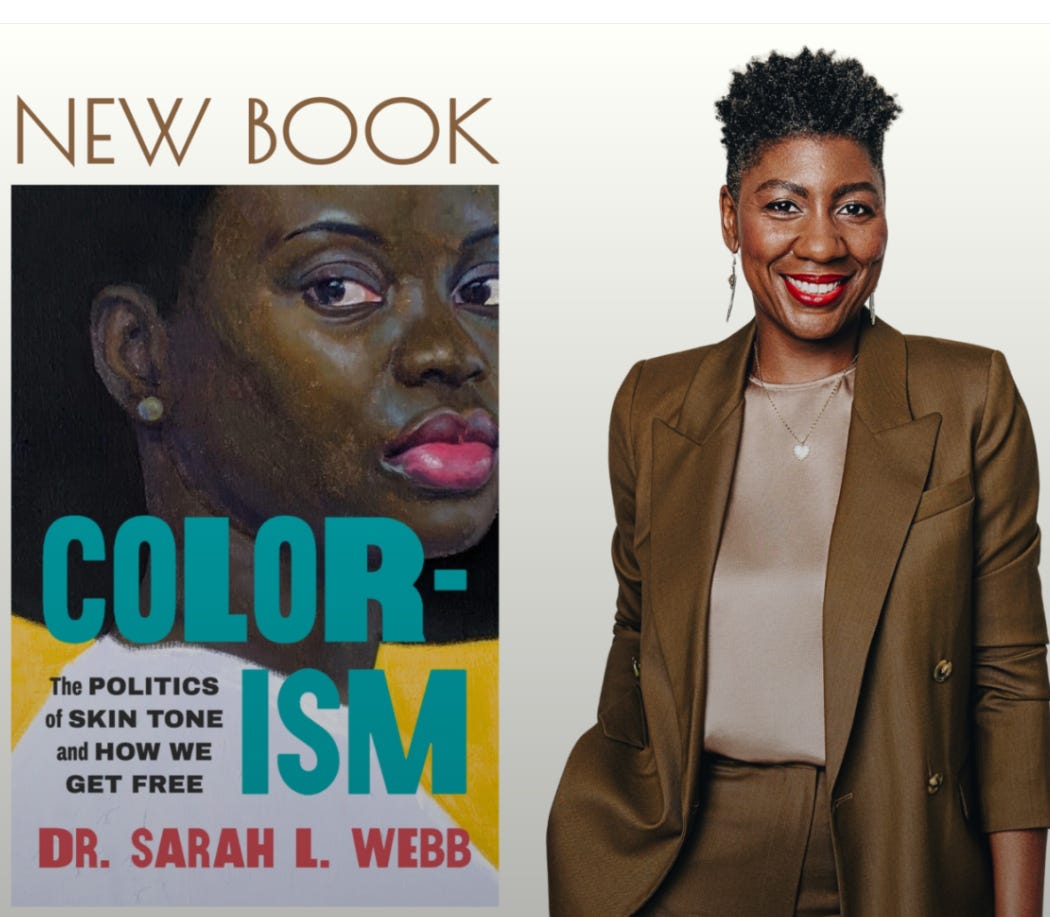
Speaking of colorism, I’m happy to share that Dr. Sarah L. Webb, the creator of Colorism Healing, has distilled her expertise and guidance on this topic into a fabulous new book, Colorism: The Politics of Skin Tone and How We Get Free.
Check out Dr. Sarah’s “Colorism is Not a Popularity Contest” in Book Riot:
“As it turns out, colorism is far more than a vain popularity contest. It is the social marginalization of individuals and groups with darker skin tones and the privileging of those with lighter skin tones. It happens both within and across many racial and ethnic groups around the world.
“These inequalities based on relative skin tone span all areas of social life, from school suspension rates, wage gaps, healthcare disparities, racial profiling, and police brutality.
“My new book, Colorism: The Politics of Skin Tone and How We Get Free, carries the torch of colorism awareness into this modern era, taking a global and cross-cultural look at how colorism impacts lives, and how every individual can empower themselves to create change.”